Making America Something (that’s for sure).

To call it a disappointment isn’t quite strong enough.

I’m never a fanboy of futility…I think there’s always something that could be done.

My issue is that the people who seem to me to be the ones who are positioned to really do something don’t, and I’m left to wonder why.

Befuddled, I suppose. Yeah, befuddled.

So sure, Trump won. That’s no surprise to me, I mean the Democrats have been paving his way since 2016 and the haters and racists have seemed really empowered and encouraged by that Elon energy lately. The Trump win is being described as some sort of mandate to roll forward, full steam ahead, with an agenda of deportation and bigotry, while the material needs of and deference to the working class is cast aside. 

Tax cuts for the wealthiest, a seat at the policymaking table for wealthy donors, and crypto, baby. Oh, and deportation and isolationism. Plus rescinding Bidens plan to reduce medication costs for Medicare and Medicaid patients.

Trump is making America something, that’s for sure.

Make America Decent Again (R.I.P. Jimmy Carter)

1/5/24

I waited a bit following the passing of Jimmy Carter (12/29) before writing this.

The response of some to Joe Biden’s comments on Carter after his passing prompted me to pay my respects. On FOX especially, there was a sensitive woke-response to Biden’s comments. A melty snowflakey vibe. Now I have never been a fan of Biden’s, but he gets some things right some of the times. This was one of those times.

When asked about what President Trump might learn from Carter, Biden said:

“Decency.”

And:

“Can you imagine Jimmy Carter walking by someone who needed something and just keep walking? Can you imagine Jimmy Carter referring to someone by the way they look or the way they talk? I can’t.”

And:

“…the rest of the world looks to us. And he was worth looking to.”

Set aside how stupid and transparent the question was.

It is laden with the understanding of how decent a man Carter was his entire life and an insinuation that Trump is something other- and quite honestly less. Someone who could learn from Carter’s example. That question, asked that way, is clickbait out loud and is counterproductive. 

Anybody who has paid any kind of attention to Trump’s very intentionally public profile knows what he is known for and he has publicly let us all know himself. Being “decent” is not really his style. Ted Nugent draft-dodging, Toby Keith boot-up-your-assing, Kid Rock beer-shootin’, name-calling, intolerant, delicate far-right angry-melting is Trump’s jam. So why even ask?

A better question:

What was it about Jimmy Carter that leaders and Americans, in general, could look to as qualities we should want in a leader- a role model in general?

So I want to focus on that.

I had seen this picture before.

Seeing it again since his recent passing was just another reminder of what a decent guy who had lived a real life Carter was his whole life. Also, it is another reminder of what sorts of things we don’t see enough of, hear enough about, or talk enough about in the day-to-day zeitgeist of the world we’re living in right now. So a quick review of the life of the man:

Jimmy Carter:

…born in 1924, the first American president to be born in a hospital, he was taken back to a house that lacked electricity and indoor plumbing. By the time he was ten, the boy stacked produce from the family farm onto a wagon, hauled it into town, and sold it. He saved his money, and by the age of thirteen, he bought five houses around Plains that the Great Depression had put on the market at rock-bottom prices. These homes were rented to families in the area.

Before he even entered high school he had written the U.S. Naval Academy in Annapolis, Maryland, to ask for a catalog. In 1941, he graduated as class valedictorian of his tiny high school.

Carter flung himself into his coursework, studying for a year at Georgia Institute of Technology in 1942. Carter was admitted to Annapolis in 1943 and graduated in the top ten percent of his class in 1946 Carter earned a Bachelor of Science degree from the U.S. Naval Academy. As a submariner, he helped build the reactor for the early Seawolf nuclear submarine.

In 1952, a 28 year old Navy Lieutenant Carter led a team tasked with clean up and repair following the Chalk River nuclear disaster. 

In 1953, Carter and his new wife Rosalynn faced a difficult decision. His father, Earl, had died of cancer, and the family peanut farm and his mother’s livelihood were in danger. Resigning from the Navy, Carter and his wife returned to Georgia to save the farm. After a difficult first few years, the farm began to prosper. He became a deacon and Sunday school teacher in the Plains Baptist Church and began serving on local civic boards before being elected to two terms in the Georgia state senate. There he earned a reputation as a tough, independent operator who attacked wasteful government practices and helped repeal laws designed to discourage African Americans from voting.

But, back to that picture of Carter:

Carter said of his attachment to country music and southern rock musicians:

 “There are some people that didn’t like my being deeply involved with Willie Nelson and Bob Dylan and disreputable rock and rollers, but I didn’t care about that because I was doing what I really believed… And the response from the followers of those musicians was much more influential than a few people that thought being associated with rock and roll and radical people was inappropriate for a president.”

Gregg Allman, showing up far too late to a reception being held by then Governor Carter for Bob Dylan and the Band, following an Atlanta show, found the lights being turned off to end the gathering and the limo being turned away. But Carter told the guards to let the limo in, and spent the evening listening to music with Allman, sharing a drink, and becoming friends. In fact, Carter spent time off and on stage with some great artists of the day.

Allman recalled that they had a drink together and then the governor said, “By the way, I’m running for president.” It seemed absurd to Allman that this guy sipping scotch and listening to deep blues might become president of the United States, but he truly liked Mr. Carter, admiring his gumption and “just folks” appeal. (1974)

I’ll get to some more in the next one, and deal with policy and politics. I think substance in this man is pretty evident. I can’t say the same for presidents since, but maybe I’m just partial to good music.

The Drive Home

10/13/2024

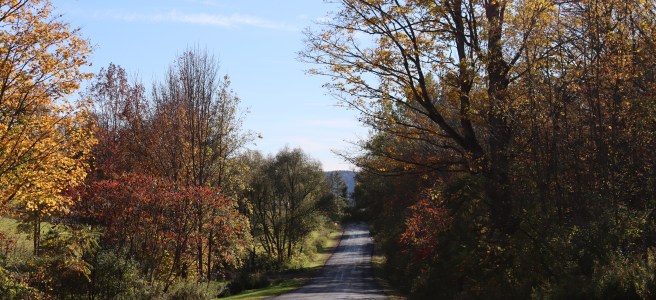
Usually when I am out and about this time of year I end up struck in the moment by the way the view and vista hit my eyes. Winding and rolling roads framed by treelines and a glimpse of a distant horizon can make what I’m seeing look like a painting I’d like to paint.

That was the primary reason for the picture above. I was driving home, the sun was shining, I had some coffee in me, and I saw this. I pulled over and put the camera I’d borrowed to good use because I saw what could become a painting. And I want to paint more.

And write more.

So here I am, I guess, writing and hopefully getting around to the painting thing at some point.

But there are other things I want to be doing more of as well.

I’ve gone on a couple recent weekend driveabouts with Dad, usually around the places where he grew up, places where I spent a lot of time when I was a boy. The stories that I tell and write, at least some of them, happened in and around these places. Often they happened to me, because of me, or happened with me there to see them and participate in them.

Or I heard them from the people who lived them. Sometimes the stories are from my father’s youth or ones his father (my Grampa) shared. Sometimes guys my dad knows or knew are in the stories, other times they were telling them…

It’s these stories I’m after. Other stories too, but it starts with the ones I already have and know-filling in gaps and finding out more.

Maybe I make some shit up or dramatize a bit, especially when I am sharing the stories of me showing off for my elementary school crush. Okay, maybe I almost always dramatize, but the people in my stories are real, the stuff I tell about really did happen, and the places exist. In fact, I am getting to them as much as I can and bringing my father along. He’s the source for a lot of the stories that happened around these places from my childhood. The stories are a little wild sometimes because these people are wild and the stuff they’ve done is wild.

Gathering and sharing these stories is my mission.

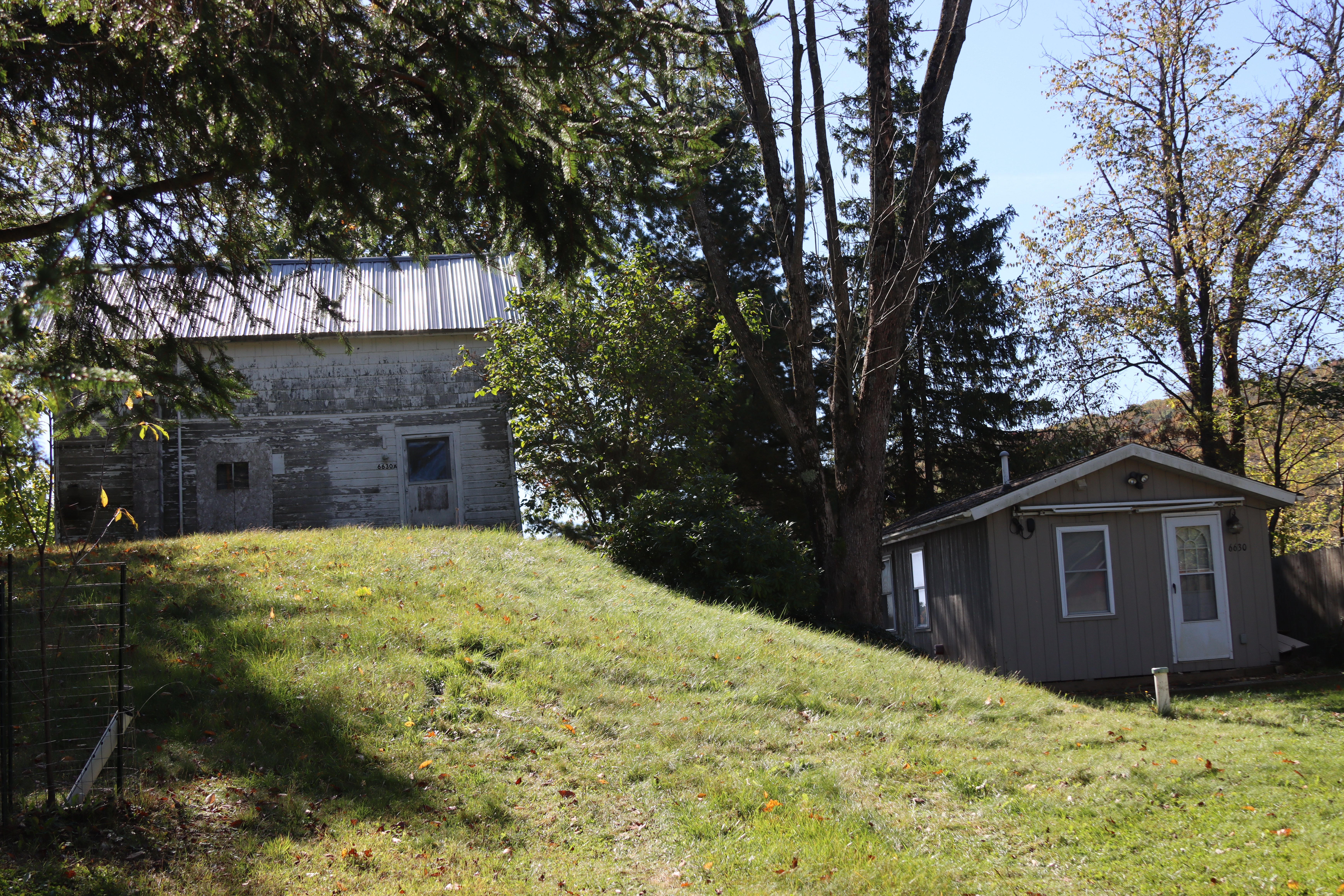
So Dad and I ride. Nearly to the other end of the county from where that very first picture was taken just yesterday. The picture above shows one of those places from my childhood, and another is shown in the picture below. It’s just up to the corner of Lake Como Road, then a right turn and a mile or so down the road. It looks nothing like it did way back then so I have to rely on my memories.

That’s why I like hearing and telling stories. People who do this preserve memories that would otherwise vanish. So I dig up mine when I can, and ask for those of others.

And Dad’s.

The Bee Tree

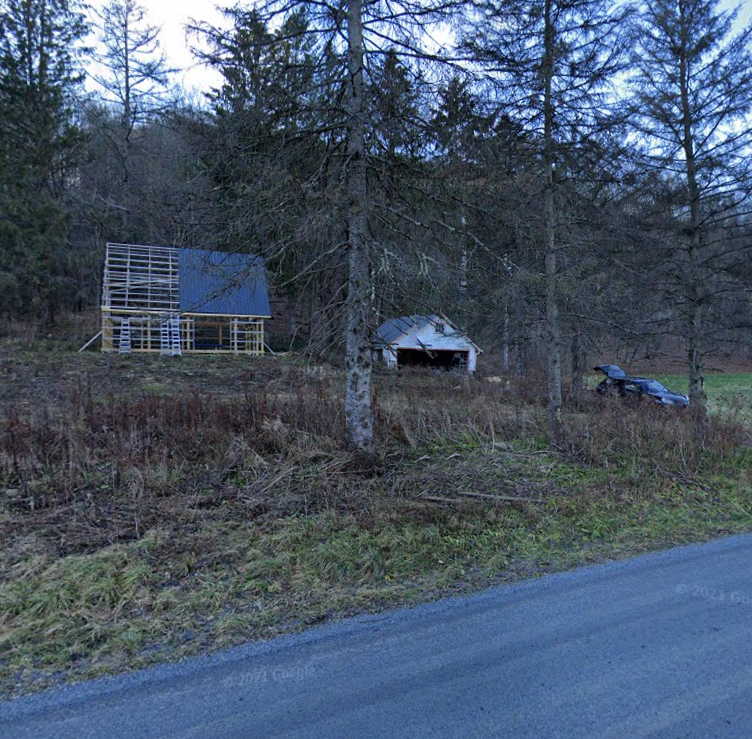
That up close tree is the “bee tree”. Or at least, it was when I was a kid. The old small barn/garage thing on the right was always there. Ever since I can remember. That mostly roof’d thing back and to the left? That wasn’t, but it’s been sitting like that for some time now. In fact, I went back in time looking for images of the house that once stood in the empty foreground of the picture, and found an honest-to-god street view of this spot. And guess what?

Back in 2021, one of those Google spycars went rolling by that very spot!

There was someone building there!

But here we are, near the end of 2024, and little has been done. It has me wondering. Mostly, though, it has me remembering back to when that new thing wasn’t there.

Back to when that tree in the first pic of this property really was the bee tree.

(Insert that mystical, tinkly, Wayne’s World sound that means we’re traveling back in time)

Little Little Danny: Off to the Races (A totally exaggerated version of imaginary events that really did almost happen about the way they’re being retold)

Little Danny stepped up to get his sled. His cousin Brian stepped up with him in the other line and the two prepared to rocket into the record books on the “alpine slide”. And to think they were getting ready to just run around Gram and Gramps just whacking the bee tree and waiting for someone to get stung. This was way cooler than that.

Not that the bee tree thing wasn’t interesting. Every year that giant pine tree was humming with hornets, and they were all around the house, and everywhere in the yard. There were no popsicles in peace or ice cream cones in the occasional calm. The sugar would bring ’em. You’d be stung for sure. That’s why it was starting to get interesting. Someone was probably getting stung, and each boy was pretty sure it was going to be the other, but neither really cared. It happened every year, a few times anyway.

It had started with “Go run around the tree twice and then back to the porch,” progressed to three times around, and even to the next difficulty level: taking the thin, yellow, wiffleball bat and whacking the tree before dashing back to the porch. That’s when the hornets became more interested. Up until then, whichever waited on the enclosed front porch would see a wisp of hornets pull away the way smoke above a candle does when your hand passes through. A few hornets would trail after briefly and then return to the tree. The bat was another story. A handful came all the way to the door and almost made it in before the runner closed the door. It was a whack-run-watch.

Still, it just seemed not quite dangerous enough for a couple of men like them. They climbed onto roofs. They snuck beers and cigars. They let Grandma drop them off at bible camp, but only because it was a chance to sneak away from campfires and songs and into the woods with church girls. So they decided the real danger from bees and such might only be elevated if they smelled more flower-like during their assaults on the bee tree. Before they could thoroughly douse themselves with their grandfather’s green, Skin-Bracer aftershave (that being the most smell-good thing a couple stinky boys could think of) the call to load up into the family wagon came. They were heading to Song Mountain and the Alpine Slide!

This brings us forward in time to Little Danny, atop his sled, at the top of the mountain, ready to ride the Alpine Slide. People have had to be airlifted away from this ride! Little Danny thought. Which is probably why the teenage kid at the top did the safety thing he did every single time to every single person, probably every year Little Danny had been coming. How to stay on the track, don’t stop in the middle, how to push the lever forward to go faster, how to pull back to…

Little Danny pushed off fast before Safety Boy could finish. Sure he was probably five or six years older, 18 tops, but he clearly didn’t know how big boys played.

 “I’ll be waiting for you!” he yelled as he pulled away from his cousin and any advice about slowing down.

He picked up speed quickly but heard Brian come up from behind on the track to his left. The wheels made a steady click-click-click when they rolled over the seams in the concrete sections of cement quarter-pipe and the curved pieces they use sometimes in the bottoms of ditches. He was ahead and laughing as Brian yelled something about cheating and racing again. That was fine with Little Danny. As many times as they wanted today, they had one of those all-day tickets. Ride as many times as you can, and five rides on the go-kart race track!

“That’s where the real race is going to be,” Little Danny thought to himself.

The jump was approaching and the cart was rolling fast. The head start Little Danny had helped, and to him, it seemed his cousin Brian was falling farther behind. Now it was time to play it smart, and Little Danny knew it. He caught just a little air, and came back down straight and true onto the cement slide, then heard that same moment of silence and then the impact of Brian’s cart behind him.

That spot wasn’t meant to be a jump, but it was a sudden dip that caused the carts and riders to lose contact with the track if they were going too fast. There were DANGER signs and WARNING signs letting riders know the spot was coming. Little Danny was pretty sure there was a CAUTION: HUNGRY BEARS sign too, but he was usually going too fast to see it clearly.

Slowing you down was the point, Little Danny knew. Making riders more safe on the track and keeping them from losing control and jumping off the track was the idea. “Safe,” Little Danny said to himself, “slow!” he laughed out loud. He leaned forward on the lever for maximum throttle.

By the time he hit the deep left curve, he was probably going faster than he ever had at that spot before. His mind had also begun to wander.

He wasn’t sure if Brian was behind him anymore. Maybe he had gone off the track already. Maybe he had rolled off and skidded into the trees.

Maybe a bear got him,” Little Danny thought. 

He was imagining a search party coming back to find Brian, after rewarding Little Danny with some trophy for winning the race, maybe a medal or two for speed, but finding nothing but a torn-up Batman t-shirt and one Converse hightop with a perfect bear bite mark taken out of it. Maybe an ankle still sticking up out of it.

Little Danny was probably laughing at the thought of his cousin Brian getting bear-bit…a way better story to tell than getting a little stung-up by some angry bees when he felt the cart kick out from under him. Suddenly he was grinding the upper right edge of the slide with the sled-bottom while his left elbow took all his weight on the other side, grinding on the cement slide as his forward motion and gravity pulled him along. He fought to stay on, to control his cart and pull it back under him.

Maybe he shouldn’t have cheated at the ready-set-gone line. Probably he should have slowed down. Okay, so he shouldn’t have imagined his cousin Brian jumping the track, rolling into the woods, and being eaten by a bear-nothing left but a gnawed ankle sticking up out of a foot still stuck into a chewed-up Chuck.  Whatever cosmic confluence of coincidences caused the conundrum, Little Danny was locked in an epic battle with the sled, trying to force it back onto the track, with his left elbow leaving some of itself on the cement slide in the struggle.

The pain in his elbow was a fire begging to be put out, pleading with him to stop, but Little Danny knew there would be no stopping today. He already had a new goal in mind. He was going to win this race, and get to the go-kart track first-where he would win again! He gave a tremendous pull back toward the center of the track while pushing off with his elbow. The wheels of the cart took back to the slide, his hands took back to the controls, and he was off again.

“Still no Brian,” he thought, as the steady clicking of his sled picked up speed and no sign of his cousin came from behind. While he began planning to check with the emergency crew to see if they could go find Brian he noticed a warm, wet sensation on his left arm and saw the red drips on his shorts. His elbow had been torn up pretty good. 

“Uh oh. If the bears smell blood I’m a goner!”, thought Little Danny, and he was extra cautious the rest of the way down. 

When he got to the bottom, the teenagers taking the sled back hesitated a little, his face going white other than the two patches of panic pink on his cheeks when he saw blood running down Little Danny’s arm, all over the left leg of his shorts, onto the sled and onto the slide. From a little hut nearby, a man came out with a worried expression and a toolbox full of bandage stuff. He patched Little Danny up, and by the time Brian rolled down, thoroughly uneaten by any bear, Little Danny looked like a brave soldier who had done battle with the slide and survived.

The two ran together to the go-kart track with their all-day, 5 tickets to drive pass, Little Danny thinking “This is gonna be good!”. 

What Comes Next for Learners in NY?

A year ago today I sent the following message to NYSED. On this matter (i.e., narrow focus on standardized test scores as the measure of value in education) I have been writing, calling, mailing, and emailing newspapers, and various publications for more than a decade. I’ve met with legislators, educators, and union folk for over a decade, attended appearances by edu-folks out on “listening tours”, and gone to protests. This letter is one of the more recent efforts to suggest common sense to people at the policy and regulation level. There’s a touch of snark in here but they really, really have it coming and have for longer than I have been doing this. My preference would be to feel like I didn’t have to do any of that stuff, but see something/say something at some point needs to become do something.

Recently, NYSED and the teachers union in NY announced an agreement to drop yearly state assessments as the primary measure for evaluating schools and educators. So it feels like a needle may have moved in a positive direction in terms of bringing reality and humanity back to the endeavor to educate. I don’t think I had anything to do with that, but what if I had done nothing? What if I had just complained behind closed doors, and plodded along waiting years and years for someone else to make things better? What if I was an “Oh well, there’s nothing we can do about it” sort? So my choice is to believe either that I was the one persistent and annoying voice that pushed for better, or believe that there are others out there who knew and know we could and should be doing something different and better for learners.

Some of this has been Grammarlized up a touch but I tried to retain the original flavor.

June 7, 2023

To whom it may concern at NYSED,

I am writing regarding the “Rebuild Phase” of the accountability system for public schools. The current air quality issue brought on by the Canadian wildfires prompted me to get this done and sent in quickly. Don’t worry, I don’t think death from smoke inhalation is imminent or anything. It could take a bunch of years for the things teachers are just expected to risk and endure as essential workers and first responders to kill me. Like a sheriff doing our start-of-the-year in-service a few years back told staff gathered to hear it: You can get shot several times with a handgun before you’re actually killed! It’s not like the movies where it’s just one shot then you keel over dead (probably), so you should keep fighting. 

So, I’ll keep on fighting I suppose.

I understand the claim that that path forward has incorporated “input from educational experts and stakeholders, including public comment from a recent public survey…” (a quote from NYSED’s School and District Accountability page).

What is required to be considered an “educational expert” and/or a “stakeholder”? I am a parent of three students who attend(ed) the school I teach in. I have been a teacher for over twenty years. I have a pretty deep and broad understanding of education policy and what has shaped it over the past decades. I have had personal communications (email, phone, and in-person) with NYSED Regents and associates-both as a parent advocating for my child and as a professional educator applying some critical thought to an accountability approach that became and is becoming more and more disconnected from the lived realities in schools. It would appear that I am expected to throw my professional and personal self into a pandemic, in front of bullets should it be necessary, into schools on days when air quality is being described as hazardous, and I have seen the destructive impact of the accountability approaches imposed from above on the learners and educators below. It feels pretty expert and stakehold-ery to me!

With that rather brief and limited scope on what I bring to what comes next, here is my input:

  1. The weight of standardized test scores needs to be reduced in the evaluation and accountability approach. A framework for tracking those measures need to remain because achievement in those areas is important, but the year-long obsession over ELA and Math assessment data has caused some vital areas to go neglected for far too long.
  1. The introduction and inclusion of more whole-child to well-rounded young citizen measures needs to happen and such measures need to be given more weight in the accountability process. This speaks to those far-too-long neglected areas back in the first “input” item. I can get into details if I need to, and this has been the topic of some of my prior communications, but I think anyone who has walked the earth for a bit and gotten themselves involved in public education gets that there is far, far more than good test scores needed to survive in the world we’re living in. Yes, those discrete skills are necessary and measured in a more cost-effective way (e.g. insisting that a state full of children be forced to take computer-based state assessments) but there are some more essential soft skills that are lacking in the approach to what schools are most aggressively held accountable for. 
  1. A cumulative portfolio of experiences should be that framework of accountability. Much like what may have been used back when the state was looking to farm all sorts of personal data to benefit curriculum and assessment vendors…what was it, “In-bloom” or something? Except this would be to benefit the student, the family, the educators, the school, the community being served. Those experts and stakeholders you want to hear from would all have skin in the game. This “portfolio” could travel with the student from intake to graduation and beyond. At the point where they become more independent learners preparing for lifelong learning, say junior high and high school, the students could review their own portfolios for gaps, strengths, opportunities…

I could honestly go on forever, and who knows. I may still. My ideas require some leaning in by the people actually doing the job, and more backing off by people who don’t. That’s where we’ll really see who honestly wants the best outcomes for learners.

Dan McConnell

Me and My X

I don’t want to start calling Twitter “X”…

…but I also don’t feel like dirtying the memory of Twitter by using her name for whatever she has become. I might be leaving her, but is there a decent alternative?

It’s me baby, not you-I swear.

I do remember something happening, in terms of creating an alternative gathering place for free and sometimes regrettable speech. Just before or around the time of the changeover from what was (Twitter) to what has become (X). And now I’m looking for options, another platform or forum. I’m doing a Friday-to Friday cleanse, so next Saturday I’ll probably open it up and do what I can to filter out the undesirable, maybe make a decision.

Will this bit of writing auto post to X the way it did Twitter?

Having a “meeting place” would be nice, because teaching has become more and more dystopian (right along with the rest of the world).

Send me a message if you have ideas. I just got a username on Mastadon but I’ll be waiting til tomorrow to look closer.

“Lie to them, Jack” (A real short read)

“Lie to them, Jack. If you do it half as well as you lie to yourself, they’ll believe you.”

Bam. 

John Locke (played by Terry O’Quinn) delivers this line to Matthew Fox’s character, spinal surgeon and perpetual hero and soul-tortured martyr Jack Shephard. Didn’t take me long to tire of Jack, and yet he was one that endured while others I liked more got killed off on LOST. Dr. Responsible seemed more or less a reiteration of Fox’s way back character Charlie on Party of Five. Remember that relentless ride of sibling family drama and angst? 

It was horrible. So much so my brother and I took to calling it “Misery of Five”.

Well, Once Charlie now Dr. Jack has spent a good portion of four binged seasons racing around trying to be mister boss-man in an attempt to weaponize moral equivalency and save everyone else for the future he has determined is right for them.

In the meantime, John Locke continues his communing with the island and doing its apparent bidding, which has put him often at odds with the doctor, despite the doctor having been shown time and time again that Locke may just be correct about what the island wants. It has been a challenge for the woe-is-me man of science to come to grips with the reality that there are forces at play that can’t really be ‘splained’ away.

I know what goes down, but I won’t spoil it. I’m just about to the point where it gets to be a bit too much, and “a bit too much” is my middle name so you know it must be too much. I’m watching on Hulu, if you get curious.

Using Mindful Structure, Stories and Enrichment to Build Both Culture and Community (and maybe improve attendance?) in School

My name was used as a verb recently.

The person that did it told me so. She even described the context in which she used my name when I asked. Maybe she was going to tell me anyway but I was so excited I jumped in and asked to hear the whole story. I mean to think: my name as a verb!

Like a force of nature almost.

Like some dynamic that might influence the world or instigate some movement or something!

Okay, I’m getting carried away. But wow. My name as a verb! 

I guess it came out sorta like this:

“I don’t mean to ‘Dan McConnell’ this, but…”

Of course, thinking back I realize I could have been the in absentia butt of some joke. Like when someone says Boy you really Shleprocked that! But in this case, I asked for an explanation because I sensed that it was a good thing. This person and I are pretty tight philosophically and ideologically, though there is a disparity in the intensity of our deliveries.

Turns out it was pretty good. I was proud to have had my name dropped in this situation.

So in just a moment here, I’m going to give my impression, like an impressionist would, of the conversation in which my name became definition worthy. But understand it’s before 5 AM right now. The sun isn’t up. My coffee has slid from out-of-the-pot hot to piss warm and I need to think it out before I write it out, which isn’t usually my way. So you aren’t going to see this happen but it really is about to: I’m going to “freshen up” as real men say.

Hey, you’re still here and my coffee is once again hot! Win-win I say. But back to that conversation where my name became a verb (because in a bit I’ll take another break to crack today’s WORDLE).

It was a conversation where one side represented an insistence that there be more lockstep alignment and assimilation, where everyone was doing the same thing, was on the same agenda, same page, and everyone knew exactly what everyone else was doing and when and how… Essentially “you will be assimilated”, join the Borg collective or the consortium, or whatever you want to call it. 

An important aside here is that in my mind, teamwork is vital, and I am not opposed to a shared agenda. In fact, if all involved in the endeavor to educate were empowered to share the agenda to actually do what’s best for learners, especially our youngest learners, I am 100% on board. But when predetermined structures imposed from outside and above demand humans be viewed and valued first by the statistically normed assessment data they produce, and diminish the value of learners and professionals who know better, you’re not doing teamwork. You’re doing surrender and compliance.

That “mindful structure” in the title gets turned into a functional structure. It’s how you set up efficiency and cost-effectiveness first and tweak for obedience and performance, not how you grow minds and culture, and community. It’s the way you train dogs and tune engines, not the way you should raise or educate young people.

And here I’m getting ahead of myself again, goin and gettin’ all preachy.

When it’s about children, learning, and people in general that happens. So here’s my description of how this man became a verb. I may lean into the drama, sure. I know I think through my feelings filter a lot when I should feel through my thinking filter instead. But my god it makes life worth living.

My name was used to put words to the thinking that children and people be treated more like the varied, beautiful individuals that they are and that maybe that is the truer path in the human endeavor to educate. 

Use my name as that sorta verb every day of the week.

Now, here’s the thing. Education isn’t simply a “human endeavor”, as in some theoretical warm-and-fuzzy concept, or one that can be allowed to be discussed in broad conceptual word-strokes.

Education does need to have a purpose, and it needs to serve a purpose. In order to meet these purposes it needs to have structure and a plan. Using Mindful Structure, Stories and Enrichment as the path, with the plan being to empower learners to engage with culture and build community, we could start making education actually feel like the human endeavor it is supposed to be.

Okay, I’m chopping here. There’s a bunch more typed below but I have edits to make, coffee to warm, lunch to pack (NYS Math test day 2…ugh). What comes next is me describing the structure I have used and like to set up. For my own daughters, for my students, and for the zone I operate in. Pretty simple, really. Simple rules, close observation and facilitation, and plenty of out-of-the-box opportunities…

I really hate them boxes. I work with roundy pegs. Okay stop, WORDLE time.

The Tiny Vampire Community, and Creepy Winery in the Woods

It was ten years ago at least. Maybe close to fifteen. I was vacationing with my wife then and we decided to do something Virginia-beautiful. Something that would take us on a scenic drive, along winding mountainside roads that might offer up a spontaneous stop-n-bite meal someplace that serves tasty southern roadkill sandwiches or critter fries.

Or a winery?

Yeah. A winery. We were given an incredible place to stay through a family connection-a place with ceiling-high windows, a “cabin” that was much more than just that, surrounded by nature. A bottle or three of wine would certainly allow one to be left unopened as a thank-you gift. Right?

So off we went in search of, with some loose awareness of where a winery might be found and one of those old Garmin GPS things to guide us along the way. Are they still around? It’s one of those devices that need to be actively updated (or at least it did back then) otherwise new roads, roads that no longer existed, current construction blocking roads you expected to be there… all of that waited as potential confounding variables in your point A to point B plan.

This on top of the fact that I am pretty hopeless when it comes to navigation, with or without GPS.

After some time we came to realize that the roads Mr. Garmin was pointing us towards, and the winery that supposedly awaited, were not where we were being told they were.

I say Mr. Garmin because I’m pretty certain Mrs. Garmin would have known what the hell she was talking about. Mr. Garmin clearly did not. So we were left to our own devices to drive on beautiful Virginia roads on a beautiful, sunny, Virginia day, looking for things to see and wine to drink. Isn’t there a John Denver song about some of that stuff? Not so much the bottles of wine-maybe that’s Rocky Mountain High I’m thinking, not Virginia Mountain Drunk.

Okay, I’m rambling. Let’s get to it.

Some winding roads and a gradual climb, and all of the sudden the trees parted. The sky opened, and out of nowhere, we were plunked in the middle of what looked like a suburban pod community. A few perfectly neat little homes, with perfectly paved driveways in front of perfect little attached garages. Perfectly mowed lawns with nothing out on them except a few perfectly pruned trees and shrubs. No toys, no lawn furniture, no trash bins by the roadside for pickup… No cars in the driveway. And we hadn’t seen another vehicle on the road for quite some time.

It almost looked like a developer’s life-sized model of a planned community. No Real estate signs, though, to indicate that these were model homes for viewing. It seemed these were homes that belonged to actual people, but there were just no signs of people.

Driving just a little bit past these homes brought us to the tippy top of this hill. The homes were gone and there were only a couple of things to see here.

On the left:

A cemetery of sorts. Or, a graveyard? I’m not sure which name should be given to a blank, sterile gathering of bodies and grave markers into columns and rows on a rectangular piece of earth. This was no “final resting place” that would be sold to folks who actually worry about the view their corpse will have from initial occupancy until a future developer buys the property and evicts the residents.

No trees. No meandering paths or drives to take. Little variation in headstones. A four-foot high chain link fence surrounded it with a gate at the entrance, a dirt road that went straight in at the gate and then split in perpendicular branches, for efficient delivery, maintenance, and no-frills visitation, I assumed. From the entrance to the back row, it was about the width of an Olympic size swimming pool.

On the right:

A small stone building that looked like one of those figurines you buy in an artsy gift shop when you’re on vacation. You know the ones I mean. Sometimes the pieces are cute cottages, sometimes lighthouses. There’s that little boy and girl that are holding hands or touching noses all “in love” and stuff. Well, this building was a cobblestone type, maybe leaning a bit towards fieldstone or a collection of stone shapes that varied a little in size. The colors were reds, and purple-ish, the type of stone you see a lot of down south.

It looked like it could be a cute home even, but here’s the thing: the windows facing the road were too small, dark, and high off the ground to be really functional as windows that would let any light inside. I think they were stained glass, but I don’t remember for sure, and if they were?

They were still small, up off the ground a bit, and dark.

On the ends of this building were small, round stained glass windows way up high where the roof came to a pointed peak. The land it was on sank away steeply from the front to the back so that a small, basement-level entrance door could be put in on either side. I can remember thinking “No way that’s a house. But man, it’s kind of a fancy little mausoleum. I guess if you aren’t spending for landscaping around the graves, givem a nice waiting room, right?”

Then I saw the sign.

Church of the Brethren.

I’m not going to spend too much time on this because religious faith is precious to those who have it. Let’s just say I had never heard of this particular religion, category, sect, or classification… And let’s be honest, “brethren” has a spooky-movie sound to it.

So imagine this eerily abandoned Virginia community, because I had pretty much written the story that way in my mind right then when it happened, and this mausoleum so-called-church that blocks out all the sunlight, which sits right across the road from collected and dutifully arranged graves and bodies…

Okay, let’s just get off that.

We kept driving while I thought “Can vampires sleep their day away in an actual church?”

Eventually, we came to a “T”. The road ended.

Yet Mr. Garmin was saying there was a road in front of us.

There was not.

It was a coin-toss decision. A shared “I don’t know, which way do you think, right or left?”

The decision was for a left turn, and off we went, believing there was a winery somewhere nearby and figuring we’d see vineyards, buildings…a sign of some sort? You know, some blatantly obvious clue telling us a winery was somewhere close by.

There was none of that, and in fact, the road began to climb again and entered into a thickly wooded area. No way there were any vineyards around here and I expected to see posted signs or markers identifying state land, but you know there I was thinking like a Yankee.

Then suddenly through the trees on the left, I could see a clearing set back a little, maybe around fifty feet in, and as we got closer we could see it was a dirt parking lot around a pretty nondescript white building. The building looked something like a small town’s village barn, the sort of place where a plow, dump truck, and other small equipment might be stored.

There was no great big garage door. Nothing around it that gave it that town lot feel. No big bucket loader, piles of gravel, stone, or sand. No sign identifying it as the town of something-or-other property. There was none of that. The appearance of this building was like the “church” in that it was sort of an odd building in this secluded location and one with a purpose that was difficult to determine.

Still, as weird and secluded as it seemed, as we neared the entrance to this lot we saw that there were about eight cars parked around the building. Not abandoned junkers, or cars waiting for repairs, but decent cars that appear to have been driven and parked there for something that was going on. Then we saw a sign. It was a winery, and the sign said there was a tasting that day!

It sure didn’t seem to be the winery that Mr. Garmin was pretending to try and help us find, but after the strange church and cemetery across the road, it was a welcome and kinda quirky pitstop. There may have been that warped storytelling voice in my head that whispered this is where the vampires keep the bodies hung for “milking”, but I ignored that voice.

It says lots of silly stuff.

So in we went, and I was quietly hoping it wasn’t me that would get “tasted” that day.

The entrance was a simple, windowless door, and inside was an unfinished barn-like interior. Overhead there were exposed beams and around there were support posts and small areas that looked like this building might have served its purpose for a small farm. You know, a smaller boxed-in space where a calf could be kept on a bed of straw, another to keep wheelbarrows and some rakes, shovels, and whatnots out of the way, a larger one where bales of hay might have been kept. No fresh folks hung by their ankle for any vampires to drain at their leisure.

The vampires’ leisure, I mean.

There were about a dozen people meandering about that looked to be customers, and a few that looked to be owner-employee types. A couple makeshift serving bar/sales counters were set up, one near the entrance and another across this space on the opposite side. There were plates with some typical “pairing” snacks and some tasting, actual wine tasting, was happening. So it looked like a legit wine-making operation. Small, but legit.

As my wife and I mingled and spoke to a couple of the folks that appeared to be attached to this winery, we discovered that they only open up for tastings like this two days out of the year, and we just happened to come across it on one of those days! An incredible coincidence, right? Moving around we met a few people, took a few sips, and nibbled a cracker or two to “cleanse the palette” or whatever the wine folks do.

While we’re doing this, I notice a thin, white-haired old dude relaxing in a simple wooden chair in an area off to the side, watching.

Just watching.

A couple of the younger employees stayed close, and they spoke a little to the little old man in the little wooden chair and he to them. While I know the resemblence was not a close one, the paintbrush that is my memory has created a charater that looked like William Hickey. He had played some wonderfully creepy roles in his time but I most remember him as Don Prizzi in Prizzi’s Honor and Uncle Lewis in National Lampoon’s Christmas.

During a conversation with a woman working at this winery, when we shared our “where we’re from stories”, my wife shared that she was originally from Sodus Point, N.Y. Pleasantly surprised, the woman said:

“Why (so-and-so) right over there is from Sodus! She’s been with us for several years!”

Near 500 miles away. Little old Sodus, NY. On the shores of lake Ontario. And here in this open only twice-a-year winery that we found accidentally.

Now how could we not talk to this person.

So, we did. It didn’t take long for my wife to get through the when did you graduate, and who do you know stuff, but most interesting was the where did you live question. My wife grew up in a white house that sat in front of a couple hundred acres of Girl Scout Camp called Camp Beechwood. Her father worked as caretaker of the camp and the house for he and his family to live in was part of the compensation, and of course it was right there close to the job.

Turns out that this woman had grown up in that same house before ending up at this winery.

Her father was the caretaker of Camp Beechwood before my wife’s father had become the caretaker.

It was at this moment my mind replayed that scene from The Shining where Delbert Grady is helping to dab a stain off of Mr. Torrence’s (played by Jack Nicholson) jacket. Torrence confront’s Grady about having been the caretaker previously, having “chopped your wife and daughter up into little bits, and then you blew your brains out,” but Torrence is a little drunk on ghost booze and just starting to realize that the secluded hotel he is in holds a lot of deep dark secrets and restless spirits.

Torrence tells Grady that he WAS the caretaker after Grady claims to not know anything about what Torrence is saying, insistently, in an I know this is true tone.

Grady responds: “I am sorry to differ with you sir. But YOU are the caretaker. You have always been the caretaker.”

It is just then that the little old man in the little wooden chair stands and announces that it’s time to go to the basement for a tasting.

Storytime: How our Stories Echo

Chloe was home from college on break. This past Thanksgiving, maybe. She and I were watching the first Pirates of the Caribbean movie, and near the end, at the point where Hector Barbosa gets shot, and is first dismissive of Captain Jack Sparrow, almost condescending-believing his undead status provided him protection at that moment from such foolishness as being shot.

“Ten years you carry that pistol and now you waste yer shot,” he says.

Here, an echo.

If you’ve watched the movie you know that Barbosa himself gave Jack that pistol with that one shot believing that the madness and suffering of having been left stranded on a deserted island would lead Jack to use that pistol and that one shot. On himself. To end his own suffering. Instead, Jack uses the pistol and his one shot to shoot Barbosa.

A moment he’s waited ten years for.

Of course, Barbosa is mocking and taunting at first, it’s part of his charm. But then he realizes Will Turner has dropped the last cursed coins and a bit of blood onto the stack gathered, finally breaking the curse that came with every one of those coins. Barbosa stands frozen in place. A remarkable moment of blaring silence following the hectic and fast-paced fight scene involving multiple participants in a cave holding untold amounts of pirate treasure, including the cursed gold that the Black Pearl and its crew had sailed the world to retrieve.

Having torn his coat open to first see the blooming flower of blood soaking through his shirt, and then lifting his chin to stare off at some nothing in particular beautiful thing, the pirate has an expression owning his face. There was a split second of surprise, maybe. He’s been bested. But his expression changed into something else.

And then he says “I feel…”

It is at this moment that Chloe hits PAUSE, freezing that face to the screen.

Another echo.

“Dad, I remember sitting on your lap watching this with you when I was like four or five years old, and you stopped it right here and asked me ‘What do you think he’s feeling right there?’” Chloe said.

“What was your answer?” I asked.

“Happy.”

We had a brief conversation at that moment, about that moment in the movie. About that expression, what it meant, the amazing delivery of actor Geoffry Rush… Even more important: we talked about the connection between the there-it-was-again frozen moment on the screen and it happened-back-then earlier moment. How when you pay attention, you hear those echoes.

Engaging with these moments when they arise, with intent, is a powerful technique for growing a mind. One of my favorite things to think about, talk about, and write about is taking advantage of the earliest opportunities to do this with young learners because it’s vital for building that brainpower. Especially as a parent in the earliest years up to five years old, but then as an educator- in that 5 to 10-year-old zone, those elementary school years.

What I really love is using it to plant those moments that can become echoes, to drop a thought, a question…to set up the moments still to come.

There must be a sense within that young mind when it dares to reach out and then makes some independent discovery.

An “Aha!” turns into an “I did it!”, an intrinsic reward and a sense of accomplishment that leads to self-motivation, an “I can do it!”. I had stopped to explore this Barbosa thing with the four-year-old Chloe in my lap, she had seen the connection to an earlier story moment, and here I was exploring it again with an all-grown-up Chloe who had paused it herself, just as I once had.

That earlier moment in Barbosa’s story, and in our story, had echoed.

As my little stinker grew into a thinker she began to see this type of connection on her own, without having it pointed out to her. She has become a brilliant writer and storyteller. We can now discuss moments like the Barbosa one in the context of technique and purpose- how similar intent applies and is evident in other movies and in other stories. Making those connections had become a collaborative exercise.

While the more formal learning environment of school doesn’t offer all of those opportunities, connecting ourselves as human beings to each other and engaging in narratives together, through our observed, lived, explored, and shared stories, is vital in providing a true education.

Once young learners become adept at engaging with stories and making all those connections with the others around them, of seeing how stories and characters evolve and how their own stories develop, they also become more prepared to generalize the skills employed to their own lives. They are better able to understand how actions and plans can be means to some ends: in-the-moment decisions, day-to-day decisions, and maybe even long-term plans.

Practicing with learners how to slow down to explore that dynamic in fiction, with fictional characters in fictional situations, and then connecting similar themes in plotlines in real-life stories around us, spotting how actions come with consequences or rewards…

It might even show that motivation and unwavering commitment can pay off!

Just as it had with end-of-movie Barbosa.

The earlier movie event in Barbosa’s character trajectory was after the crew of the Black Pearl had raided Port Royal, called there by the power of the last gold coin. The character of Elizabeth Swann, a prisoner of the pirates for having given the name Turner instead of Swann, stabs Barbosa. Much like in the later scene, he is dismissive and even menacing. It’s about to be revealed to “Miss Turner” that these are no ordinary pirates.

Barbosa says:

“Look! The moonlight shows us for what we really are. We are not among the livin’ and so we cannot die, but neither are we dead. For too long I’ve been parched of thirst and unable to quench it. Too long I’ve been starvin’ to death and haven’t died. I feel nothing. Not the wind on my face nor the spray of the sea. Nor the warmth of a woman’s flesh.”

There is real desperation in the man’s eyes as he tells her this. He isn’t relishing the murderous spree and pillaging. He is desperate to truly live again. To feel.

That moment when reflected back upon makes the final “I feel…” There was an echo for Barbosa there. He lamented the “too long” he had gone without feeling a thing, and now he was almost euphoric, realizing that he could finally feel. There was an echo for Chloe and I as well. The powerful moment in the movie had woven itself together with a powerful moment of ours that echoed from the past where we had shared it all then in a way that helped us to share it again nearly twenty years later.

So how can educators use this idea of echoes and connections to benefit their students in school?

1/23/2024 This is an edited version of the original.

It Starts With Stories

Preface:

I tend to bring in a lot through a feelings filter. And I don’t just attach my own personal feelings, sensing my way through some situations when it might be better for me to just take a deep breath and “slow my roll” (as people way cooler than me might say).

My thing is I sense the feelings of others and sometimes think into that a little too much. Sad songs, sad movies…Ohmigod when kids in a movie suffer or struggle in some horrible situation despite their wide-open hearts and hope for a better future?

Shit, I’m crying for sure. Please don’t look at me. Or maybe I’ll just go to the kitchen quick to “grab another beer” or “get a snack quick” (a.k.a. do whatever that excuse I made up was but also quickly wipe the tears away on my shirt before I return).

So many moments like this while watching different movies, and for different reasons. It isn’t always about the kids. Loving Vincent is probably the best most recent example. It shook me. It was one of those movies I walked away from really happy that I saw it but really sure I wouldn’t be ready to watch it again any time soon. It so engaged my love of story, my sympathetic take on what I already knew of van Gogh’s life as well as my passion for art and music… That movie brought paintings to life, made them move and speak and tell that story. And it was heavy. Wow.

I want to see it again. But I think it needs to be with others, on a nice day, with a brief drink and snack plate intermission somewhere. Try to give it a trip to France sort of feel to keep it light. And then do something really fun with those people afterward.

The kids thing, though? That one is tough. The movie My Girl hit me pretty hard and I won’t ruin it for anyone who hasn’t seen it. But even worse, Radio Flyer. I just went to snatch and drop that link there and only saw the briefest of a promotional summary,

When the younger brother is subjected to physical abuse at the hands of their brutal stepfather, Mike decides to convert their toy trolley…”

…and I’m already feeling it. I loved that movie for how much it made me hate it, and I have gone back to the ROKU a few times over the past few years to see if it’s streaming free on one of the channels. Over a decade and it still hadn’t. Is it that popular? I’m going to check again in a bit just to see, but I’m not sure if I’m ready to watch it again.

Like these movies, the stories I’ve been told or the ones I have lived became powerful life memories, lessons, and reference points through the emotions attached to them. From the ones where I made a righteous Tom Sawyer fool of myself trying to get the attention of my Becky Thatcher (her name is Carla), to the stories I was just witness or audience to… The ones told to me by my family members, stories have entertained me, taught me, altered my perspective, my outlook… These stories affected how I parent and how I teach.

My belief is that for people, emotions attach themselves to our lives events and that makes those events become “stories”, making them more indelible and retrievable for information that can be used later on. It’s why oral histories and oral traditions are so important. It’s how we share who we are and become aware of who others are. It’s how we convey lessons, successes, failures, culture, and so much more. It’s how families and communities connect and spread that feeling of belonging, of commitment, of shared purpose.

What follows is going to be a bit of all of that, along with the suggestion that we try to push for public education to be a tool for true engagement of learners with their world and the others who are in it through more engagement with stories. Real-life stories, made-up stories, stories from the page, or stories on stage… The current trend to measure, label, and dehumanize the goals, purpose, and process of education has had negative impacts- especially in this age of screen addiction and perpetual distraction and misinformation. I’m saying we need to slow down, come together, and share more stories. And I’m saying there are great reasons to do it, and great ways to do it.


Just went to check. Radio Flyer is still in the pay extra to get it category.

So click here, and it’s on to storytime.