Snow Day Magic (as well as other powerful and essential magic)

Note: There will be multiple references to magic, and many places where this text seems to turn around and bite itself in the ass and be self-contradictory. Don’t let any of it throw you off, just read it to enjoy it and when you come out the other side you will probably be okay.

I’m starting this at around 10 AM on Tuesday, February 28th, 2023. Normally at this time, I would be wrapping up an activity with two students who qualify for extra support services to reinforce their skills in the area of mathematics. Instead, I am home in my pajama bottoms and a favorite St. Lawrence University t-shirt, with my tootsies wrapped in thick wintry socks that are like soft little blankets for my feet. My belly has a few “sea waffles” (little waffles shaped like sea horses, crabs, and dolphins) in it. Only real maple syrup will do for those, and I finished off the pot of coffee by adding a little cream and some cocoa mix to it.

It’s all part of the spell. Snow Day Magic. So special it deserves to be capitalized like that and for more reasons than I can probably get to here. But I am going to try.  Also, I might try to get to other types of very important magic, as well as explain why none of it is actual magic, before telling why we should all be casting more spells.

Let’s start at the beginning

It isn’t really “the beginning”, in terms of magic, but if we’re talking Snow Day Magic I would be remiss if I didn’t touch on 2014 for a moment. My three daughters always enjoyed a snow day, other than me blazing into their room as soon as I got the news to pounce on their bed, bounce them awake, scaring the bajeepers 1 out of them with the good news before hastily running out and into the next room for a repeat performance-daring them to try and get back to sleep. 

Clearly, as a teacher, I like snow days too. I have come to learn that there are rituals one should observe if calling in a snow day is the goal. Now, I don’t remember any of these rituals from my own childhood, but kids these days have a list of “to-dos” for when the weather looks as if it might lean in that direction. Give Mother Nature a little nudge, you know. The rituals I am most familiar with are listed below2.

  • Wearing your pj’s inside out
  • Putting a cotton ball under your pillow
  • Placing a pencil in the freezer
  • Flushing an ice cube down the toilet
  • Doing the Snow Day Dance™

I can get into the actual scientific principles that are involved in the cause-effect dynamic between these rituals and the results but you first have to understand that it’s not an actual science and the causal relationship probably can’t be validated. 

But boy is the pretending fun, and isn’t that what magic is all about?

So here I am, or there I was as it were in 2014, wanting to gift my girls (and me) with a surprise day off. I didn’t just wear my pajamas inside out. I wore them inside out and backward. I didn’t just sleep with a cotton ball under my pillow, I did so with four-one for each of my three girls and one for me. Same with how many pencils went in the freezer and how many ice cubes down the toilet. Last but not least: the dance. In the past, I had just “winged it”-making up some on-the-spot wiggly stuff. This time it was carefully choreographed and included a chant of sorts. Arm motions, ninety-degree twist, step, kick…A little regrettable in terms of things you might see a grown man do, but good magic can be good while being ugly too. That might be why I have always been a fan of Penn and Teller.

In the end, the results spoke for themselves. I felt obligated to let people know of my involvement in the weather event that resulted, both out of a sense of responsibility and as a warning intended to inform anyone else’s future efforts involving Snow Day Magic. 

Fast forward to Monday, February 27th, 2023

Holy cow, what happened to me? I went and got old and two of my daughters are off to college, living life and all…Damn. If I Could Save Time in a Bottle, you know. (*sniff*). Apparently, my youngest daughter has internalized what was learned in 2014 because as I type this, I, my pajamas, and my driveway bear witness to the very real but nonexistent magic this family is capable of.

So here is what happened:

Last night we pulled into the driveway after having to cut Drama Club rehearsal a little short because our school, as others around us had, was shutting down after-school activities to send folks home to safety. Apparently, bad weather and dangerous driving conditions were on their way. Pulling into our driveway, and putting the car in PARK, I say to my littlest angel, Ella:

“You know, we might just have to work up some Snow Day Magic.”

And yes, I even speak it capitalized like that. Seems like it can’t possibly be true, and it isn’t, but that’s really how I do it.

Ella says, “You know you better not say something like that because if it doesn’t…” 

I don’t remember the exact words but it was a translation of don’t go getting my hopes up because she sorta believes. 

You see, “believing” is a thing that runs in my veins as it did my people before and my children today. “It’s a gift,” one might say3, and it’s one that keeps on giving despite the protests of family members, children, students, colleagues, strangers on the street… We believe in magic, in a sense. The rituals and the other weird stuff that happens around me bear some indirect power that outright silliness has for influencing impressive and amazing outcomes. It brings an audience in and inspires them to participate and believe, and the feeling of satisfaction and sometimes wonder inspires further participation…

When I first showed her the news of a two-hour delay this morning, her respect for the power was probably reinforced. When I returned a short while later with news of the full cancellation it was certainly cemented. She came downstairs about five minutes later, looked me in the eyes, and said “I think this calls for waffles.” The next hour was filled with me blasting my Dad-music, singing along with Elton John, Cat Stevens, and Billy Joel while my youngest and I consulted each other on mixing, measuring, and eating…

It was magic.

Non-believers sometimes find it unbearable. Which makes it all more fun.

Santa used to call my house to talk to my daughters back when my dead hippie friend and poker buddy Coop was still alive. I’ll always swear it was Santa and not Coop, but he could coincidentally do a really good gruff and not quite entirely appropriate Santa impersonation. To this day “Santa” (a different one that is busy typing right now) leaves notes for my family congratulating the girls on what amazing human beings they are, apologizing for the mess the reindeer left, the beer swiped from the fridge, thanking us for whatever snacks get left out and disparaging the behavior of the man of the house.

Apparently, he’s the only naughty one out of them all. 

Jack Steam swipes messages on the bathroom mirror that reveal themselves when someone showers. Jack Frost does the same to cold-weather windows. I know both Jacks well. We go way back. The messages are sometimes a little wrong. Thankfully when the girls were little there were a couple of responsible parents to help debrief children exposed to such stuff. 

Well, there was one responsible parent, at least.

Magic. All of it. The best kind of magic, too.

So sitting in the driveway with a hopeful daughter, what is a naughty dad to do? 

Refer to that earlier list of rituals, except this time it was Ella hitting them hard! Sure, my pj’s ended up inside out and backward. Of course, I did the Snow Day Dance™. But it was Ella that put three pencils in the freezer, and she flushed five ice cubes down the toilet. 

Again, let’s let the results speak for themselves.

You don’t have to believe in the magic, simply observe how it works. Because magic isn’t real and doesn’t really work magically. But in the same way that Penn and Teller know exactly what the #%$& they are doing (and know that magic isn’t really real and have spent much of their careers revealing so), they know how to make the end product seem powerful and magic. You can make great things happen when you believe you can make great things happen.

Now know that this Dad is also a teacher. 

What if teachers were empowered to draw learners into a more exciting, engaging, and nurturing education instead of being compelled to force-feed children grit and rigor on a mind-numbing and unnatural daily schedule in order to pick apart and analyze what comes out the other side after endless scat-hunts? 

What if schools were a preparation for life and engagement with real-world people, places, and opportunities?

What if educators could provide a truly “least restrictive environment”, as opposed to factories that measured, labeled, and used a cohort-to-standardize approach on little human beings? 

I have had discussions where I suggest a more developmentally appropriate and humane approach to early education and sometimes these discussions end with “That’s fine for your girls, Dan, you could just sit them in a corner and they would learn,” or “Well, that’s (the factory model) what we’re told we have to do so we have no choice.”

Both things are true. You could sit my girls in a corner and they would still learn. We are being told we have to do that other thing.

Actually, I believe that only one of them is truly true. 

My response: It wasn’t ever magic. Magic isn’t real. It’s called first engaging and then preparing independent lifelong learners. When you see the results you can’t deny that the results might seem magical, especially in this day and age where children seem less and less willing and capable of achieving outcomes realized by the highest achievers. But outcomes aren’t an accident, results speak for themselves, and shouldn’t real educators be empowered to work their magic with children who need that sort of “magic” the most?

I am not special, my ideas aren’t new or unusual, and many teachers I speak to agree, but fall back on the helplessness of weak-willed soldiers made to feel that they must comply with less-than-magical approaches. Has the time come for people who know better to demand the freedom to bring better?

Footnotes

  1. Shit
  2. These are to be used cautiously. “With great power comes great responsibility,” and all. Engage with magic of this sort at your own risk.
  3. Or a curse, others might say.

That Old Expired Jar of Mayonnaise (Part 2)

It is a good idea to read Part 1 (an event from the Spring, of 2022) before this piece if you haven’t. Even though this post is about an event that happened prior to that (the previous fall), the setup of the two is me providing this one as a backstory for Part 1. IF YOU HAVEN’T, GO READ IT NOW.

Fall, 2021

The return to live and in-person learning in the fall of 2021 was sure to be an exciting, challenging, energetic, almost combustible experience.

I had written clear directions on the board and had materials and prompts and discoveries in their locations. I had prepared a scavenger hunt of sorts to reacquaint the children with each other, and placed name tags at seats around the tables I had switched to years ago, having realized that for me student desks were a far greater pain in the ass than they were a convenience. It was one more thing to manage, including all the things a desk ends up holding-things that should be in a desk, and things that should not.

The four rules for my classroom were posted in at least eight different locations. Finding these rules was, in fact, one of the find-it-if-you-can items on the scavenger hunt. I had those rules all over the place on purpose, and every year I point them out. But by the time I do, on day one, the students already get that those are the rules. I mean, they’re everywhere and they just really seem like rules when you see them and see that they are everywhere.

I created this four-rule list early in my career, one that now spans over two decades. They came to me after having participated in at least a couple “hug the children and make them feel respected” type professional development offerings. These were largely focused on a classroom discipline approach that pretends to put students in the driver’s seat when it comes to establishing classroom rules by involving them in a leading conversation-one where the rules land pretty much where the teacher wants them to begin with.

I hate wasting time that way when it comes to rules.

The foundation for an effective lifelong learner, a great part of which is structure and rules, needs to be simple and easily understood so it can be generalized to more early-stage learners. I have rules when I teach. Pretty much the same rules I had as a child myself, the same rules my parents had, the same rules my daughters had… I think the same rules most decent people I know have had. They rarely needed to be listed the way I’m about to because the words might be slightly different but when you see someone succeeding either in school, at work, or in life in general, chances are they learned and internalized a similar set of all-purpose rules. My rules are:

  1. Listen
  2. Follow Directions
  3. Be Polite
  4. Do your Best

What we’re really struggling with in school is less about gaps in ELA and Math achievement and more about gaps in student experiences with structure and with basic rules like that, as well as appropriate rewards and consequences attached to those things. The lack of character, responsibility, and respect that are the products of structure and rules are the hurdles standing in the way of their achievement. Educators are perpetually directed to and held accountable for achievement in discrete skills and standardized assessments, away from long-established, understood, and researched-based developmental progress and practices.

Remember that scavenger hunt?

Maybe not. I ramble and go off on tangents but let me just say that my goal was to watch how these children would handle getting tossed back into the crazy, hectic, smelly, noisy salad of the classroom, as well as the rules that exist in the structures and confines of in-person, down-and-dirty learning.

Well, they were thrilled. They were happy. They were getting back together with friends and peers they had seen little or nothing of since the beginning of the pandemic and now here they were! Most couldn’t give two shits about rules, directions on the board, or any of that type of stuff. Oh their seat, sure. The novelty of a teacher that had tables instead of desks, yes. But what was written on the board?

Psssht. There were maybe three who got right to the tasks described on the chalkboard while still engaging in the more social aspects of this reunion and the “work” of day one/morning one, which was mostly social anyways. Most mingled and bounced around the room oblivious to any direction clues or cues that attempted to guide them toward a routine or requirement.

Now, as kids can and will, they DO notice the things you sometimes hope they don’t.

I set it up so that someone might because I wanted to see if any would, and sure enough one did: the package of Oreo cookies barely peeking out from a semi-bad hiding spot high on the shelf. That was Eva who announced it loudly to the class. The other item that got noticed by Eva, again loudly, was a little jar of Hellmann’s mayonnaise sitting tucked back a bit on the top level of a bookshelf that sat behind his chair in his little teacher’s corner of the room.

“Hey, why do you have that jar of mayonnaise?” Eva shouted.

Having already started to realize that this group would have to be eased gradually back into civility from their largely feral existence during remote learning, and having already noticed that Eva was the sort to notice, think about, wonder about, and ask about everything except what she should and should not be doing, I decided to use a strategy mastered over the course of my lifetime.

I decided to wing it and throw out some confusing bullshit, just to get kids thinking.

“Oh, that mayonnaise?” I said, gesturing back to the jar. “Because… you never know.”

Here I nodded wisely as if having some experience knowing that keeping some mayonnaise around might come in handy. I told them how I had kept it for years and years, and just never gotten around to using it or throwing it away. They got curious and wanted a closer look. There was a little bit of investigation to find the expiration date (about three years earlier). I cracked the crinkly plastic seal around the rim of the jar and wondered aloud how old, expired mayonnaise might smell.

I realized a majority of the students were still caught up in the excitement, less focused on the activities he had set up for them, and knew I needed their attention. I also knew that kids are always watching and listening, especially to the adults who are near and are just waiting for something interesting to latch onto. Especially if it’s tasty, naughty, off-limits, privileged information, and so on.

So instead of yelling for their attention and demonstrating weakness and frustration in the face of adversity, I simply skooched my puffy, comfy green chair to front and center, facing the room to sit down and pretend to have a think.

I then put on my best, helpless, what am I to do now face, leaning forward with an elbow on one knee, reaching into a pants pocket with my other hand.

From my pocket, I withdrew a small, black, rectangular object. It was black, and it was a dull, flat black. It was about the size of a Zippo lighter. The whole reason I had it was exactly because it looked like a Zippo lighter. During the summer break before the beginning of the school year, I had done a brothers-get-together to help one move day, and one of my brothers had an object exactly like it. He had never been a smoker so I was a little stunned until I saw him carefully pluck and pull a pair of folded-up emergency readers from under the flipped-up lid, open them up, and then put them on.

“I could really use a pair of glasses like that,” I thought. I figured that having them in my pocket might come in handy if I walk to someplace in the building while forgetting my regular pair of glasses. Also, I almost immediately thought:

That looks enough like a zippo lighter, I can mess with some kids’ minds with that thing in my pocket!

A hush began to fall as kids noticed and some whispering began “Mr. McConnell’s got a lighter!”

Of course, it was one of those kids-notice-what-you-hope-they-don’t moments, but it was one where I knew they would and I wanted their undivided attention. I kept a somewhat perplexed look on my face as I absentmindedly flipped and clicked closed the cover of this Zippo-like thing to accentuate the lighter-like characteristics.

When the kids had gone quiet, except for you-know-who (Do you remember her name?) who shouted “Mr. McConnell-why do you have a lighter???” I pretended I was woke from my at-my-wits-end trance.

“Oh, this? It isn’t a lighter. Check this out.”

Very gingerly, like a street magician doing some kind of up-close trick, I carefully pulled the glasses out and unfolded them much as my brother had. There were some “ooohs” and some “ahhhhs”, and Eva yelled:

“Why do you have those???”

I got to deliver the message I would go on to deliver at least a hundred times from that day up to nearly the end of the school year.

“Well, I know I’m forgetful and tend to leave my real glasses (I take them from the top of my head) here or there and walk away, and end up needing glasses to read something. Having these in my pocket keeps me covered for those situations because, hey…you never know. You know, like that mayonnaise back there. Don’t forget, you never know.”

Now, you read Part 1, right? You know what’s going to happen with that mayonnaise after the state tests are done, right? What the students didn’t know in this moment we are in, or the one that will be after those tests is this:

I planned to play this “you-never-know” mayonnaise bit all year long, tweaking it occasionally, until the night before the day after state tests were all done. The stress, the ridiculousness, the scripted and onerous nature of assessment as it is currently done…All would be apparently eased out of my teacher’s soul by a big, sloppy, nasty spoonful of old, expired mayonnaise shoved into my mouth the day after tests were done. You’ve read about it so you know.

But the reveal is that the night before, I took that jar home and thoroughly cleaned it out, and filled it with vanilla pudding. Back onto my shelf it went the next morning, ready to play a starring role in that other piece I hope you already read.

The shadow cast by NAEP

Following the October 24th release of “The Nation’s Report Card” by the National Assessment of Educational Progress (NAEP), it’s no surprise that the rhetoric of education reform is once again on the rise. In reality, the tide of assault on public education had only receded a little in the quiet between “Race To The Top” and COVID. 

Now, on the heels of the pandemic, if you choose to believe it’s actually over, NAEP has provided important data that should be no surprise to anyone but is likely to be used to steer us even further away from the real reforms needed if better educational outcomes are desired.

Take, for example, the words of  U.S. Secretary of Education Miguel Cardona when talking to reporters about the NAEP results. “Appalling and unacceptable,” he said. Also, “This is a moment of truth for education,” and “How we respond to this will determine not only our recovery but, our nation’s standing in the world.”

“Our nation’s standing in the world.” My lord, you couldn’t write it more silly and lacking in substance, and this guy is the head edu-honcho for the entire country? Implicating public education in the threat to or erosion of our nation’s standing in the world indicates either ignorance or willful deflection from the stuff that actually does make us look bad to the rest of the world. 

We have been going about education reform all wrong and so-called leaders in education,  are largely to blame. The misguided assault on this human endeavor should end and we should engage in real education reform.

Dropping Pebbles in the Pond

I don’t know that this quote has been accurately attributed to Mother Theresa, but some time ago I came across a meme that did. The quote was:

“I alone cannot change the world, but I can cast a stone across the waters to create many ripples.

Think about that concept. 

It’s unlikely that an individual or individual actions are going to create a world-changing difference. There are standouts in history where big things happen due to the ideas and actions of individuals, but on a day-to-day basis, faced with the challenges put in front of humanity in today’s world, the thought that one person alone can change the world for the better is a bit of a reach.

And yet there’s a reason we know who Mother Theresa is.

Whether it was her that said it or not.

I DO like the idea of ripples as a way to affect change.

Casting a stone though…Sure there are ripples. But it skips away and across, leaving that trail of expanding rings. Neat enough, but as a teacher, I’ll use a stone when I’m looking to smash a window or get attention. 

Like a teacher should, you know.

But my approach when I’m educating, which when you think about it is changing the world for learners’ through their perceptions of the world and their approaches to it, and this is whether I’m speaking of my own children or about students in my classroom, is more about dropping pebbles than casting stones. 

More ripples. More intersections. More influence. More opportunities.

Many pebbles when I can, and right where I am. I want to be in the ripples. I want to see them intersect and interact, I want to watch what happens when students see them. I want to collect the data on what happens when I know that they do and are reacting to that.

Then I want to use what I see to decide where more pebbles should be dropped.

I’m the teacher. I have been doing this for over twenty years and in my time before and in my time now my world has rippled across hundreds of years of collective experience in education and intersected and been influenced by every sort of little pebble from state legislative leaders of education, down through commissioners of education and state department regents, down through superintendents…down to food service workers, custodians, health office staff, parent volunteers, board members…

It has never really been education or schools that needed reforming, but a game is being forced into play as if it was and is. The world is placing its burdens on schools and educators are being expected to pretend that it’s the school’s responsibility to fix the world. This is where Mother Theresa nails it, I think. And she did it in this interview almost twenty years ago, around when I started teaching.

 “There is a poverty in your country that is just as severe as our poorest of the poor… In the West there is a loneliness, which I call the leprosy of the West. In many ways, it is worse than our poor in Calcutta.”

Our “American Exceptionalism” culture drives us into separation and isolation.

We are expected to accept “the economy” as the measure of our success as a people, and in schools that economy has become standardized testing data. The norming of results to take that data and further dehumanize a human endeavor has turned our eyes further from the children and more to the screens, machines and spreadsheets that only facilitate further dehumanization of the human endeavor to educate.

The way real educators should.

Those are some pebbles from my one hand.

In the other, I’m still holding a stone.

If the world is to be changed, I think that’s how to get it started. With the right pebbles dropped in the right places at the right time.

I had a bit of a break from my last podcast episode, and I’m still trying to nail down the platform and approach. The next one will get into examples of how I have actually made that pebble and ripples thing work. A little twisted, a lot of fun, and very effective!

Real Educators and Real Education Reform

This might just be the first segment of the first episode of a new podcast.

Hello all, welcome. Come in, find your seat, or I guess find a seat- I won’t be assigning any yet so it’s okay, just grab the spot you want for now and if there are any problems I’ll move people around. Just know that if you choose to sit next to your bestie I’ll be watching to make sure you can do that and still make good choices.

Let’s get some definitions out of the way first. Since this effort I’m making here is called Real Educators, and Real Education Reform I should share the hows and whys of my using the terms “Real Educators” and “Real Education Reform”.

First, “real educators”. In my mind, if you are involved in any way with guiding learners as they come to grips with how to navigate this world we’re sharing, then you are a real educator. Most of the time my frame of reference will be how that is happening within the public school paradigm with a focus on classrooms and hallways.

But from parents to police, from presidents and their favorite porn stars to the guy at the newsstand on the corner selling the rags that reveal the darkest secrets of presidents and their favorite porn stars…

Everyone plays a role, so the key is paying attention to the role you play and the potential that lies within. 

You can make a difference, and chances are you do make a difference, but do you know that you can and do make a difference? 

Do you know that what you do and how you do it is a part of the education of others around you sharing this world with you? 

Do you think about what that difference you make might be or could look like? 

Maybe you see it as incidental or insignificant but it isn’t at all. All those tiny interactions add up. No matter how brief or in passing they are, they, and you, make a difference. Even tiny ripples travel and spread to the edges of a pond. Like the muppets sang on Sesame Street, they’re the people you meet when you’re walking down the street each day- except now you know that in the lives of learners you are those people. You are those ripples.

So sure, as a teacher my primary focus is on that role and other roles within the day-to-day school setting but having played that role for over twenty years the number one thing I have learned is that I am only part of the “real educator” team. A chance meeting, an every morning or afternoon hello from a fellow familiar…from cashier to construction worker, from preacher to police, all of these other humans tell us something about the world we are living in and tell school children as well. From puppets to porn stars it all informs us as we move forward through life. And if you are lucky enough to come across porn that incorporates puppets-definitely let me know. 

Purely for research purposes you know, I am a licensed, professional educator. Your children are safe with me

A Story (Part 1)

Little Danny stepped up to get his sled. His cousin Brian stepped up with him onto the other track as the two prepared to rocket into the record books on the “Alpine Slide”. And to think that only an hour ago they were getting ready to just run around Gram and Gramps whacking the bee tree and waiting for someone to get stung.

This was way cooler than that.

Not that the bee tree thing wasn’t interesting. Every year that giant pine tree was humming with hornets, and they were all around the house, and everywhere in the yard. There were no popsicles in peace or ice cream cones in the occasional calm. The sugar would bring-em. You’d be stung for sure.That’s why it was starting to get interesting. Someone was probably getting stung, and each boy was pretty sure it was going to be the other, but neither really cared. It happened every year, a few times anyway.

It had started with “Go run around the tree twice and then back to the porch,” progressed to three-times around, and even to the next difficulty level: taking the thin, yellow, wiffle-ball bat and whacking the tree before dashing back to the porch. That’s when the hornets became more interested. Up until then, whichever waited on the enclosed front porch would see a wisp of hornets pull away the way smoke above a candle does when your hand passes through. A few hornets would trail after briefly and then return to the tree. The bat was another story. A handful came all the way to the door and almost made it in before the runner closed the door. It was a whack-run-watch as hornets tapped and bounced off the glass of the porch door.

Still, it just seemed not quite dangerous enough for a couple men like them. They climbed onto roofs. They dumped entire pixie sticks into their mouths and washed it down with the sting of ice-cold Coca Cola. They snuck beers and cigars. They let Grandma drop them off at weekend bible camp, but only because it was a chance to sneak away from campfires and songs and into the woods with church girls.

So they decided the real danger from bees and such might only be elevated to the level of their courage if they smelled more flower-like during their assaults on the bee tree. Before they could thoroughly douse themselves with their grandfather’s green, Skin-Bracer aftershave (that being the most smell-good thing a couple stinky boys could think of) the call to load up into the family wagon came. They were heading to Song Mountain and the Alpine Slide!

Which brings us forward in time to Little Danny, atop his sled, at the top of the mountain, ready to ride that Alpine Slide.

People have had to be airlifted away from this ride! Little Danny thought. Which is probably why the teenage kid at the top did the safety thing he did every single time to every single person, probably every year Little Danny had been coming. How to stay on the track, don’t stop in the middle, how to push the lever forward to go faster, how to pull back to…

Little Danny pushed off fast before Safety Boy could finish. Sure he was probably five or six years older, 18 tops, but he clearly didn’t know how big boys played!

Make or Break Time for Education

As an educator, I saw an opportunity in the return to school after that COVID-induced stretch of remote learning.

Not that COVID is really over, as much as people want to pretend it is. Right now it feels like we are fudging our way through the positive tests and the obvious illnesses. Back to knowing that if a parent has no daycare options, a sick kid might be sent to school. Onward, implementing the merest measures as a society in order to keep people at work, and students in school, protecting economic interests first.

The pandemic revealed our society for what it really is.

Regardless of what political party holds the reins, it would appear that a market-driven strategy that defers to efficiency and easily quantifiable outcomes wins out over the human endeavor of educating. If a truly educated and capable citizenry were the goal, how we design and implement the systems that allow us to educate would reflect that. There would be more honesty in policy language coming down into our schools and classrooms from above, and it would be more about learners and a comprehensive, whole-child look at their needs, less about the limiting boxes on spreadsheets filled with standardized test scores.

The opportunity I saw in the return to in-person learning was a chance to rethink our priorities regarding the goals we are setting for students.

A reach for our better selves and a higher purpose in our service to students and communities is needed, and I feel we are in a make-or-break moment for choosing to do that. The data we are mandated to collect officially is far different than the data we are compelled to collect by the multiplying realities in the moments instruction should be happening. Those “confounding variables” keep popping up to get in the way of better outcomes.

What data educators collect matters. How we use it to build understanding about the learners as developing human beings with needs and inform our educational decisions matters more. Empowering the people actually doing the work matters most.

What Education Should Mean

I have long advocated for a better direction for education reform

Educators should be building a culture for learning, not standardization and perpetual testing, especially post-COVID. It’s not that I don’t think education needs to be done better-it absolutely does, and that’s why I am 100% pro-reform. But I am interested in real education reform. I’m talking about the type of education reform that turns our eyes away from screens, machines, and spreadsheets, education reform that empowers educators to attend to the learners as if they were actual living, breathing human beings right in front of us, because that’s what they are.

Don’t just take it from me, there are people who tell it better.

“But our obsessive need to measure academic progress and loss to the decimal point—an enterprise that feels at once comfortably scientific and hopelessly subjective—is also woefully out of tune with the moment…” (Stephen Merrill, April 2021)

      Merrill describes in that article the epic mistake of obsessing over “learning loss”, warning about focusing too much on the soulless bits and pieces of standardized assessment data during pandemic recovery. It’s a suggestion that we focus instead on the social/emotional return and support-allowing the bits and pieces to rise up from that foundation, the way it once did for the majority of students who once, long ago, arrived at school secure in themselves and ready to learn.

That article also states:

     “If there’s a pressing need for measurement, it’s in the reckoning of the social, emotional, and psychological toll of the last 12 months.”

     The best way to do that in the school setting is through culture-an approach to each other and our shared priorities and goals realized through instructional practice that includes a prioritization of social connections. Socratic Seminars are one example of how this can be worked into instructional practice. Another example, maybe even more powerful, is through storytelling.

On that foundation/culture:

     For years “Great Books” (or Junior Great Books) has been my response to the “What are your ideas/what should we do…” questions. What I really meant was the concept/approach, not that program specifically. There might be some meat on that carcass but I’d be building culture not buying more programs. The thing I loved about G.B. is the Socratic seminar format it relies on. It is engaging, challenging, and inspiring, given the right selection of texts to dive into.   

     I think using it in the youngest grades would include a lot of that morning meeting, What is the best way to take turns, …ask a friend to play, …say “I’m sorry” focus as the cognitive weaving is being done to establish social skills and consistent, reliable classroom and discussion norms. Once learners become acquainted with the thinking/sharing/ discussing around real life in and out of school, those skills can be turned towards exploring those issues and themes in what they read and in what they write about.

The Socratic Method is a way of thinking that involves three steps:

1) An initial definition or opinion.

2) A question that raises an exception to that definition or opinion.

3) A better definition or opinion

  Guided by a facilitator, individuals experience the three levels of Socratic dialogue, which are conversation, strategic discourse, and meta-discourse…

     That’s a technical definition. Execution in practice could vary a little, as the original purpose was to dissect a concept not pursue content. But teachers already engage students in this way (or something close to it), so it’s not an out-of-reach skill. Through specific activities like morning meetings and “fishbowl” discussions, it’s already done. Some teachers just have that instructional style and continually engage learners with thought-provoking questions, discussion, guided reflections and then follow-up questions, and so on.   

     Developing these skills (weaving that cognitive net) in K-12 would move that test score needle, and it might even create an eager reader/writer or two along the way. It will most certainly create learners who engage each other more productively. A more purposeful and systemic approach to creating a community of effective thinkers/questioners/ collaborators by doing Socratic seminars catches us bait that lands the fish that will fill our bellies with better test scores. 

On a personal note, this was/is my approach to my parental role in raising my daughters, and often is my approach to teaching.

     I don’t just talk a lot because I like to. I like to mess around with ideas and words and present them quickly in novel ways and I like to keep learners’ minds “on the hook”, with ideas followed by questions, then letting the line loose on occasion to see how they swim, letting them free when they’re ready to swim on their own. Whether it’s a content issue or a behavior issue I want the learner engaged in a thought-response-thread that keeps them weaving that net. Remember that net?

     So while my daughters have certainly suffered some, they are leaders because they are thinkers and reflectors. Their ideas today are a result of nurturing and engagement, and they learned early how to put good thoughts into good words. Why I remember clearly the day Chloe spoke what was (according to Jenn) her first full sentence:

“Momma, is that a crappy sidewalk?”

     With that one sentence, our little one demonstrated: great vocab skills, great recall and connecting concepts to words, presenting her idea in the form of a question to seek feedback and more ideas- a more concrete understanding (pun intended). She was out for a stroller ride around the block when we lived in Cortland, and you know how tree-lined streets in town tend to have sidewalk issues as roots heave cement and seasonal erosion takes its bites. The first thing Jenn told me when they got back to the house was the big “first sentence” event, and I couldn’t tell if it was a “proud tears moment for the scrapbook” thing, or a “this is because of the way you talk around her” thing, but casual talk and pointed and purposeful questions turned into reflective and responsive conversations as they grew. The McConnell’s “Socratic seminars” still happen, often around the family dinner table, but they are a little more demented these days.

We can’t go back in time with our students to create “ready to learn”

     …but I think we can work at establishing a foundation for and culture of learners in order to fill some gaps in that readiness while inspiring more to start weaving on their own and with each other. It will make their personal mission to learn more personal, meaningful, and relevant to their sense of belonging, to who they are, and to who they want to be. This is where storytelling comes in.

As educators we should embrace an understanding that storytelling can help educators make connections with each other and with their learners, making all feel valued and giving incentives to participate more. It is a path to better understanding, for both the listeners and the tellers. From cave paintings depicting the realities seen by long ago “historians”, to the epic oral tales of traveling performers, to stage performers and comedians like the late, great George Carlin, reflecting on our existence and sharing stories has educated us in ways that phonics drills and spelling tests never could and never will.

In my classroom, storytelling is one way I make connections and draw students in to engage their academic skills. Personal stories of my multiple foolish Tom Sawyer attempts to impress my personal Becky Thatcher (Carla) hit just right with students at that age. To know their own teacher was once living it and to have that connection makes them more tuned in to literary elements like plot, sequence, detail, characters, motivation, problem/solution… It’s about their teacher! Of course I don’t reveal that right away, but they catch on quick that the main character, “Little Danny” was me.

When I turn the stories I tell into short one-page stories they read, they are far more willing to write several sentences about the character traits of Little Danny and the mistakes he made, including descriptive details of the consequences. Some of these students, now grown, remember those stories and even the name of my crush. They remember the results of my foolish attempts to impress because those connections were built through the telling of the story. With that model to work from, students are better able to identify and track narrative elements of texts and stories they encounter, as well as start building the skills needed to develop narratives independently.

Conclusion:

Teachers need to be teaching with more stories. Not just stories in print or those read together and read aloud in class. I mean telling stories, sharing experiences and bits of themselves in a way that models for students how they can do that too. When people tell stories they provide their audience windows of opportunity to better understand the world, the others in it, and the experiences others have and are having. Creating communities of learners who engage in this practice would help strengthen the social and emotional connections humans crave and are sorely lacking in today’s world because this type of connection is what really matters to social animals such as ourselves. Stories and story sharing are primary ways learners build background knowledge, from cradle to grave, that they carry into their learning experiences.

An invitation to story time

This is a description of, and an invitation to, an endeavor that is purely for the enjoyment in participating and value in whatever takeaways you find. The path and destination are TBD, but the jumping-off point is gathering initial interest, in this school and in others around us, from former professors and teachers I know, and writers in the area. I’m collaborating with SUNY prof David Franke and we’ve spoken about what might come next down the road, but at this birth-of-an-idea stage, there’s no submitting for approval. There’s no post-conference survey, which means it’s no inservice credit thing. Right now it’s more of a gathering together, feel-good, self-care, soul project, SEL thing: 

Who doesn’t have a “got pulled over” story?  Have a “my favorite teacher” story? And everyone has a “What was I thinking!?” story! We tell stories from morning to night because they’re informative. They’re how we make sense of our experience. They’re a generous way to share what we know. The best stories are crafted, and for that, storytellers need a good audience.

Dan McConnell (Marathon SD) and David Franke, (Seven Valleys Writing Project, SUNY Cortland, English) would love to have you join us, first online and then in real space, to practice our stories. Our stories do not have to be about school and teaching, but we figure that will figure in. To put it another way, we have heard a lot of badly told stories (the news is an example), but we get few opportunities to tell our own.

If you are interested in listening or maybe even telling, you are already on your way to supporting the skills your learners need. Feel free to reach out and learn more, maybe even participate.

dmaxmj@gmail.com

More on Enrichment

Introduction

Public education has moved too far away from whole child and developmentally appropriate practices. The shift over the past decade-plus has been towards an endless pursuit and analysis of data that serves less humane motivations. This data, generally gathered through standardized assessments and representing student acquisition of discrete skills, is far too valued in the “how should we educate children” wake left behind the education reform and accountability movement from over a decade ago. Enrichment is the best way to shift the endeavor and focus back on the actual learners and their needs.

So what can we do?

Some of this long drive to Data-Town is beyond the control of classroom teachers and public schools. Through the Every Student Succeeds Act (ESSA) there are funds tied to efforts to “closing gaps” and accountability through data collection. States, my supposed teacher-union stronghold of N.Y. included, have had to develop plans for collecting statistically normed data for purpose of comparison, ranking, tracking of progress, and accountability.  

Now I like data and I crave information. Accountability, though, is a double-edged sword, and for a long, long, long time the only edge discussed is the one that cuts schools, educators, and in the end, students. Statistics I don’t like so much. I call it dishonest math for gentle liars, but I can understand why some choose to reach for numbers instead of truths and hug spreadsheets instead of children. I have little respect for it all, but it’s a fun thing to do with numbers if you’re not hurting people and it’s a low fence and a light lift. You get to avoid the hard truths.

My main issue, which I think could be largely resolved through enrichment, is that government agencies charged with oversight in a human endeavor like education continuously preach a caring message while perpetually falling back on that sterile and inhumane numbers-driven accountability bottom line. 

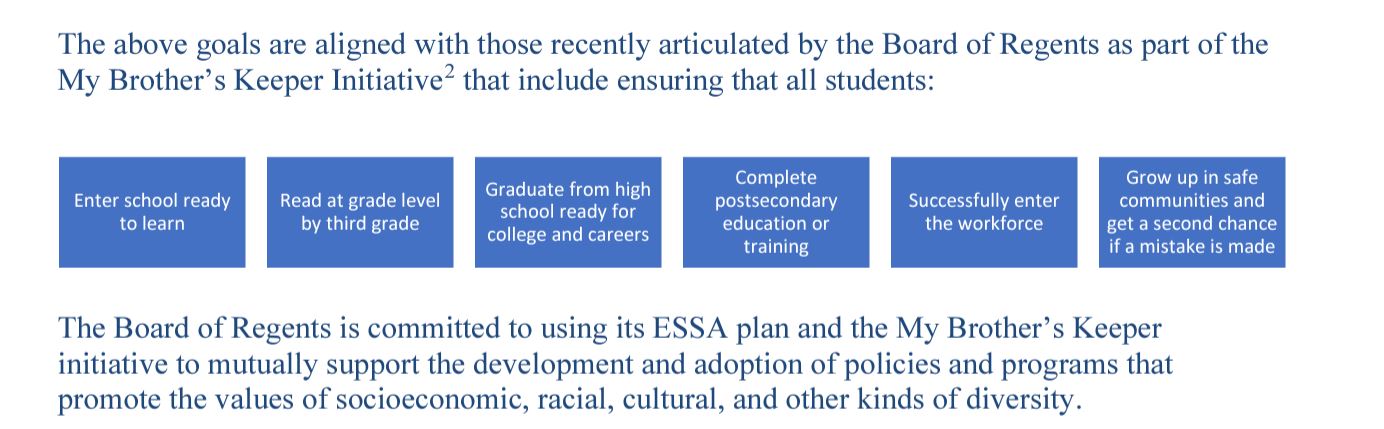
Take, for example, the goals of the My Brother’s Keeper initiative meant to close and “eliminate opportunity gaps” for boys and young men of color, and all students.”:

From p.7 of the 2020 revised NYSED ESSA plan

It’s easy to see that these are sequential goals, from entering school to a productive post-education life. The “Grow up in safe communities…” at the end is a sweet and hopeful goal.

But what about the first goal: “Enter school ready to learn”. Why is the Board of Regents, the body regulating public education, weighing in on what happens before students even arrive to participate in the public education they are regulating? What control do they have over what happens to students before they even arrive for day one of their public education?

“Ready to learn” happens at home and they know it. They know it, you know it, I know it…It happens in the community before they enter school. Otherwise, they enter not ready.

I need to gather my thoughts for part II. I’ll be getting more into enrichment when we get there.